

SCOTUS just detonated a political earthquake: Texas can keep its new congressional map, a ruling that reverberates across every state now eyeing mid-cycle redistricting.
Republicans gain up to five House seats, Democrats lose Jasmine Crockett’s district, and the nation’s highest court signals that states are free to decide their own maps.
But looming in the background is a massive court case that could transform political maps across the country — and deliver a backbreaking blow to the Democratic Party.
The Supreme Court on Thursday cleared the way for Texas to use its new congressional map in the upcoming 2026 midterms, granting a major victory to President Donald Trump and GOP leaders who have pushed a nationwide strategy of mid-decade redistricting to shore up Republican control of the House.
The unsigned order blocks a lower federal court ruling that found the map likely unconstitutional on racial-gerrymandering grounds and said the boundaries could not be used.
The ruling, which arrived just days before Texas’s December 8 candidate filing deadline, means the state can proceed with a map expected to flip as many as five Democratic-held seats into the Republican column. With Republicans currently clinging to a narrow majority, those pickups could determine the balance of power for the final two years of Trump’s presidency.
The justices said the lower court “likely did so in error” when it blocked the map and criticized the panel for failing to honor “the presumption of legislative good faith by construing ambiguous direct and circumstantial evidence against the legislature.”
The Supreme Court also said the district court violated the Purcell principle, which warns federal judges against making late-breaking changes to election rules.
“The District Court improperly inserted itself into an active primary campaign, causing much confusion and upsetting the delicate federal-state balance in elections.”
Justice Samuel Alito, joined by Justices Clarence Thomas and Neil Gorsuch, wrote that it was “indisputable” the “impetus for the adoption of the Texas map (like the map subsequently adopted in California) was partisan advantage pure and simple.”
That assertion is legally significant because federal courts may not intervene in partisan gerrymandering cases. The constitutional question is whether race — not politics — drove the design of the districts.
Left-wing Justice Elena Kagan dissented, writing that the majority “disserves the millions of Texans whom the District Court found were assigned to their new districts based on their race.” She accused her conservative colleagues of usurping the role of the trial court.
“The majority can reach the result it does – overturning the District Court’s finding of racial line-drawing, even if to achieve partisan goals – only by arrogating to itself that court’s rightful function. We know better, the majority declares today. I cannot think of a reason why.”
Texas Attorney General Ken Paxton celebrated the ruling, declaring, “The Big Beautiful Map will be in effect for 2026. Texas is paving the way as we take our country back, district by district, state by state. This map reflects the political climate of our state and is a massive win for Texas and every conservative who is tired of watching the left try to upend the political system with bogus lawsuits.” Gov. Greg Abbott echoed him: “Texas is officially – and legally – more red.”
Attorney General Pam Bondi also praised the outcome, posting, “Federal courts have no right to interfere with a State’s decision to redraw legislative maps for partisan reasons. A federal district court ignored that principle two weeks ago, and the Supreme Court correctly stayed that overreaching decision tonight.”
Democrats blasted the ruling as a blow to minority representation. Texas House Minority Leader Gene Wu said, “The Supreme Court failed Texas voters today, and they failed American democracy. This is what the end of the Voting Rights Act looks like: courts that won’t protect minority communities even when the evidence is
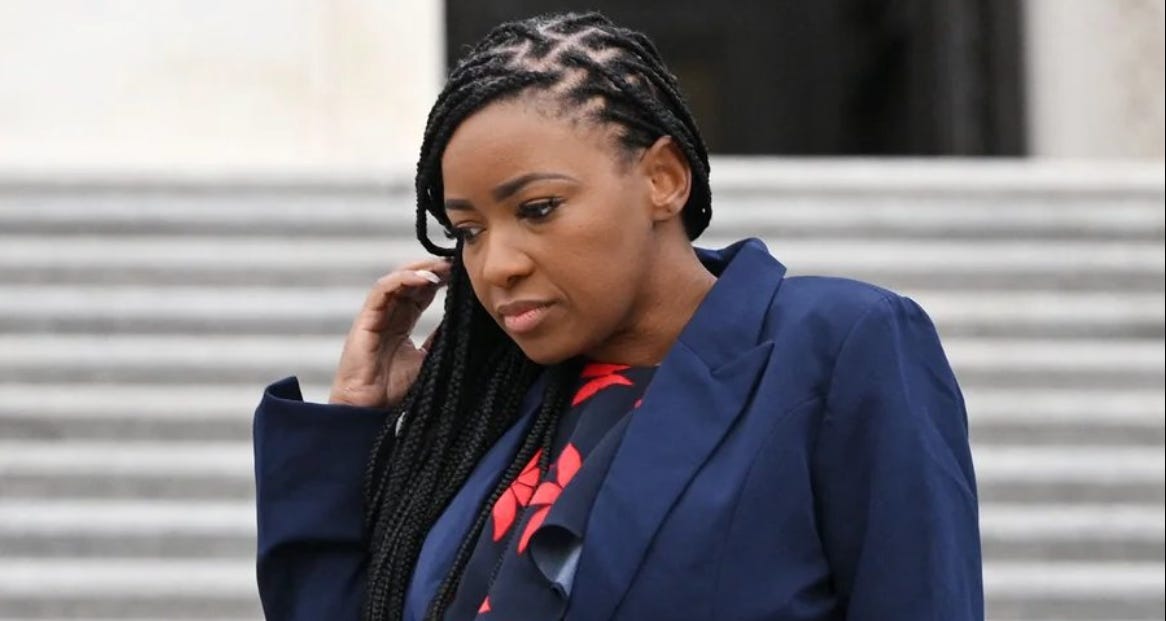
The political ramifications were immediate. With the Supreme Court’s ruling clearing the map for use, Democratic Rep. Jasmine Crockett is now officially being drawn out of her current district and is expected to face a difficult path to reelection or be forced to run elsewhere, a shift already ricocheting across Texas political circles.
The decision arrives in the midst of an escalating national redistricting war triggered in part by Trump’s calls for Republican-led states to redraw boundaries mid-decade and by Democratic counter-moves in blue states.
Virginia
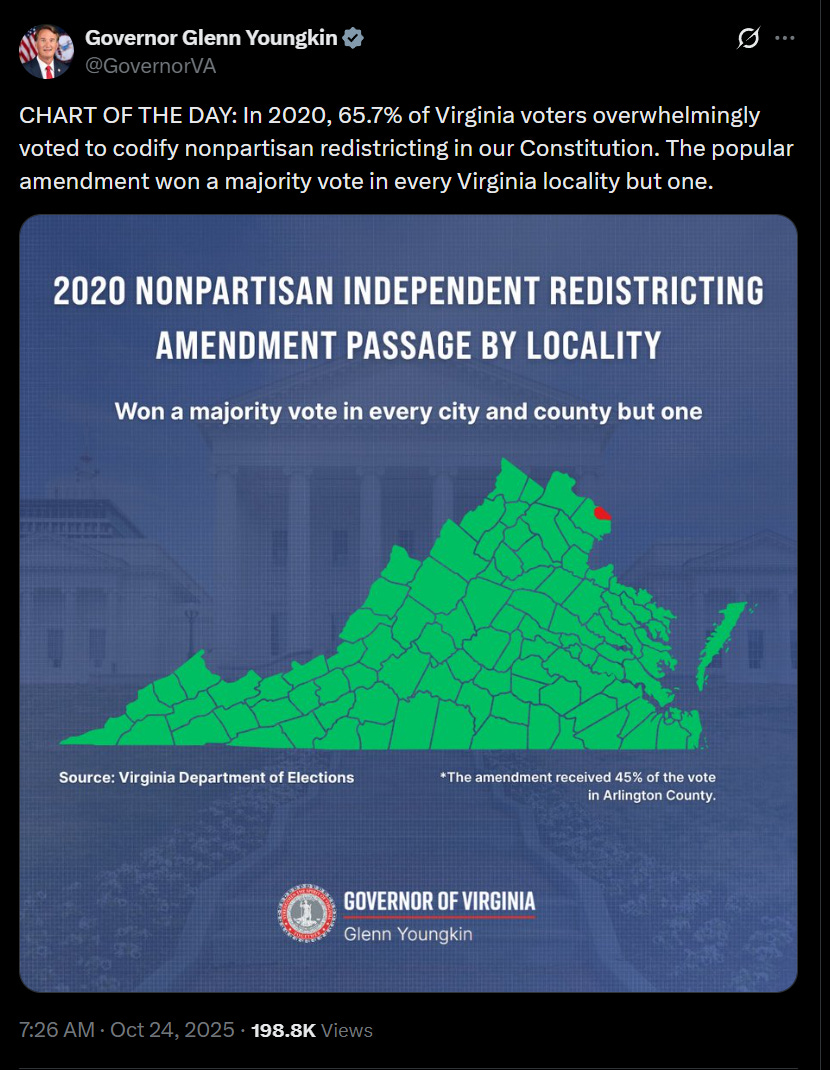
Virginia Democrats have already passed the first step of a mid-decade redistricting plan expected to add at least two Democratic-leaning seats once voters approve a constitutional amendment next year. Republicans have thus far failed to prevent that effort from advancing.
California
California Democrats, responding directly to GOP mapmaking in Texas and Missouri, pushed through Proposition 50, producing a new congressional map that could net Democrats up to five additional seats.
The Trump administration has joined a lawsuit alleging the plan is an unconstitutional racial gerrymander designed to boost Hispanic voters without legal justification. A three-judge panel will hear arguments later this month.
Indiana
In Indiana, Republicans—under pressure from Trump allies—advanced a new map in the House, though the Senate remains divided on whether to adopt it. Missouri Republicans have already dismantled Rep. Emanuel Cleaver’s district to engineer a GOP pickup, a move now tied up in court and referendum challenges. Other states, including North Carolina, Utah, Ohio, Maryland, Florida, and New York, are either actively redrawing their maps or facing lawsuits that could reshape their districts before 2026.
SCOTUS to Rule on Election Powderkeg Case
The stakes are enormous. The Supreme Court’s Texas ruling also intersects with a major Voting Rights Act case currently pending over Louisiana’s map, one that could redefine federal oversight of racial discrimination in redistricting and potentially unravel decades of precedent governing majority-minority districts. Many legal experts believe Thursday’s decision signals where the majority is leaning.
From the start, the Texas case was complicated by a letter from the Biden Justice Department urging the state to redraw four districts it claimed were unconstitutional. Texas officials later cited that letter as evidence race had to be considered, a rationale that then became the basis for the lawsuit accusing the state of improper racial line-drawing.
US District Judge Jeffrey Brown found that “the governor explicitly directed the legislature to redistrict based on race,” which placed the map under a high level of scrutiny. But the Supreme Court’s intervention prevents the lower court from enforcing its ruling ahead of the primaries.
Texas argued that failure to restore the map would cause statewide “chaos,” pointing to the looming Monday filing deadline and active campaigns already underway. The Supreme Court agreed, applying the Purcell principle to allow the map to stand at least through the 2026 cycle.
Political strategists in both parties now acknowledge that Trump’s mid-decade redistricting strategy—paired with Democratic counter-maps in blue states—has set off the most volatile and fast-moving redistricting environment since the 1960s.
Bottom Line
The Supreme Court’s ruling does more than settle a Texas dispute; it effectively greenlights aggressive mid-decade redistricting across the country so long as states claim partisan—not racial—motives.
That single distinction now determines whether federal courts may intervene at all. And the Supreme Court may strike down the Voting Rights Act’s section 2, thereby eliminating that final premise for obstruction of state redistricting.
The Supreme Court is currently considering a case, Louisiana v. Callais, that could significantly weaken or effectively gut Section 2 of the Voting Rights Act, which prohibits discriminatory voting practices based on race. While the Court recently affirmed Section 2’s prohibition of discriminatory effects in a 2023 case (Allen v. Milligan) by upholding the requirement for a second majority-Black congressional district in Alabama, the current case raises new questions about the role of race in redistricting and the ability of voters to challenge purported discriminatory practices.
In practice, this would give lawmakers, especially in states with unified control, enormous freedom to redraw maps in response to shifting political winds or presidential pressure, as Texas, Missouri, Indiana, and North Carolina have done.
Republicans gain one of their most important structural advantages heading into midterms that will determine whether Trump governs with a friendly House or faces a divided government. And with states from Virginia to California scrambling to redraw in response, the political map Americans vote under in 2026 may look dramatically different from the one they used just two years earlier.