

For nearly a month, Americans have been left wondering what really happened to Sen. Mitch McConnell.
On Sunday, the longtime Kentucky senator finally broke his silence, releasing both a photograph and a lengthy written statement about his health. But rather than putting the controversy to rest, the carefully managed rollout has only raised more questions.
The photo itself appears intentionally designed to prove it is current. McConnell is shown sitting beside his wife, Elaine Chao, holding this weekend’s sports edition of The Washington Post while recovering at a rehabilitation facility.
The statement, meanwhile, insists McConnell did not suffer a heart attack or stroke, says he was briefly unconscious after a fall, later developed a “mild case of pneumonia,” and is continuing rehabilitation before eventually returning to the Senate.
But after weeks of conflicting reports, many Americans are still asking whether that explanation tells the whole story.
Just days ago, CNN released previously unseen footage showing McConnell being wheeled from his Washington residence on a stretcher and loaded into an ambulance. The network also reported on eyewitness accounts from neighbors describing a significant emergency response outside his home.
Separately, emergency dispatch audio from the day referenced an unidentified patient who was reportedly unconscious, with “cardiac arrest” and “CPR in progress” mentioned during the call. While it has never been conclusively established that those dispatch details referred to McConnell himself, the timing of the emergency and his hospitalization naturally fueled widespread speculation.
Now comes the official explanation.
McConnell says there was no heart attack. No stroke. No concussion. No broken bones. No tumors. No hemorrhages.
Instead, he says he briefly lost consciousness after falling and later developed what he describes as a mild case of pneumonia while recovering in the hospital.
That account immediately raises obvious questions.
If pneumonia became a significant part of the reason he remained hospitalized for nearly a month, why wasn’t it disclosed weeks ago?
If doctors have subjected him to “every test they can think of,” have they actually determined what caused him to suddenly lose consciousness?
And perhaps most importantly, if McConnell is healthy enough to pose for a carefully staged photograph and release a lengthy written statement, why not simply record a two-minute video for the people of Kentucky?
Instead, what readers received was a statement that many viewed as looking more like a polished public relations document than a candid medical update.
The structure is familiar.
It opens with reassuring “fight for Kentucky” language.
It acknowledges public concern while appealing to the realities of aging and privacy.
It emphatically denies the most serious medical possibilities.
It explains the lengthy hospitalization.
It assures constituents he is still working behind the scenes with staff and Senate colleagues.
It says he still has “unfinished business.”
And it ends by thanking everyone for their prayers while promising to return as soon as doctors allow.
Whether intentional or not, the statement follows a well-worn political communications playbook.
The timing also makes the situation especially significant.
Kentucky is approaching an important legal deadline surrounding how a Senate vacancy would be handled if one were to occur before the end of McConnell’s term. At the same time, Senate Republicans are navigating one of the most consequential legislative periods of President Trump’s second term.
McConnell has long been one of the Republican conference’s most influential institutional voices and one of the most outspoken skeptics of several America First priorities, including efforts to advance the SAVE America Act.
His absence matters.
It also comes just days after the death of Sen. Lindsey Graham, another prominent Republican senator whose absence has altered the political dynamics inside the conference.
One detail that stood out to many readers was that McConnell’s statement never mentioned Graham, despite emphasizing that he has remained in regular contact with Senate colleagues throughout his recovery.
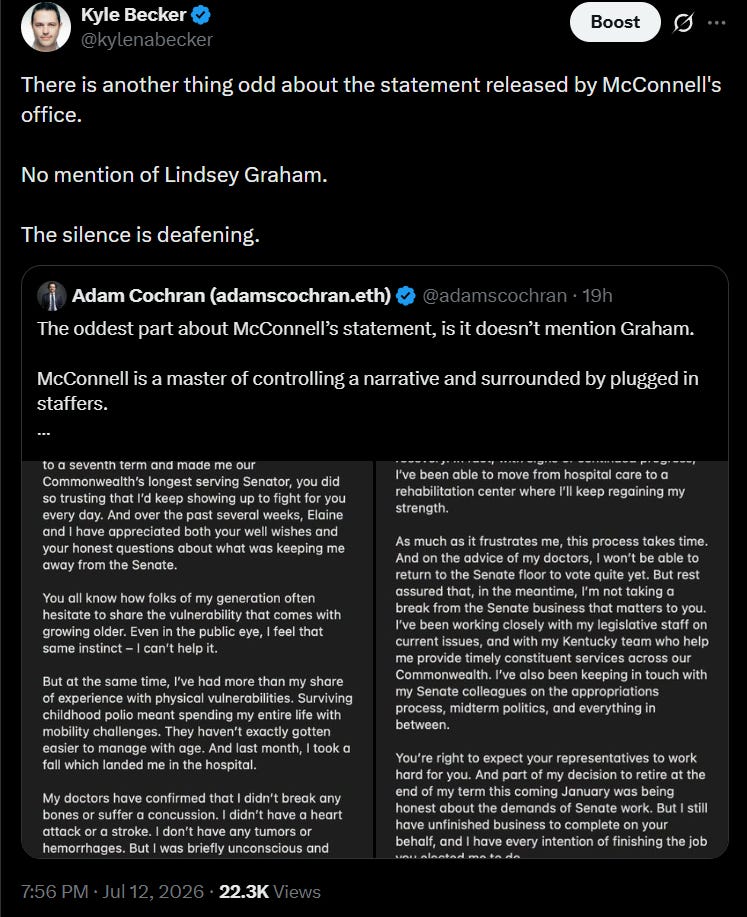
Ultimately, none of this means McConnell is obligated to disclose every aspect of his private medical history.
But when a sitting U.S. senator disappears from public view for nearly a month, is transported from his home by stretcher, remains hospitalized for weeks with virtually no public updates, and then reappears only through a carefully composed photograph and written statement, it is entirely reasonable for the public to continue asking questions.
This episode also revives a broader debate that Washington has repeatedly tried to avoid.
Americans watched the final years of Sen. Dianne Feinstein’s tenure unfold amid repeated questions about her health and ability to serve. Former Rep. Kay Granger’s prolonged absence sparked similar concerns.
Now McConnell’s hospitalization has reignited the conversation once again.
Congress sets minimum ages for serving in federal office because lawmakers recognized that maturity matters.
Perhaps it’s time for an equally serious conversation about whether or not members of the U.S. government should have age limits.
The statement was ridiculous and the photo looked shopped. A.Joke.
On X, the picture released of McConnell and his wife, has been proven to have been originally posted in 2023. Grok confirmed what people already observed. I believe they are just stalling until Aug 3 because if recent changes to their election/appointment rules.